Loading…
अन्नं बहु कुर्वीत। तद् व्रतम्॥
Why is Anna Daan called the greatest daan?
What the scriptures say about food, the stories of Maa Annapurna and of Karna, the bhandara that Maa Vaishno Devi herself asked for — and why families mark birthdays, anniversaries and remembrance days with anna seva.
According to the scriptures
Food is Brahman — the meaning of annadaan
In the Taittiriya Upanishad the sage Bhrigu searches for the truth of existence, and his first realisation is that food is Brahman: from food all beings are born, by food they live, and into food they return. Feeding another being is therefore seen as serving life itself.
The same Upanishad gives two simple vows: “make food plentiful”, and “never turn away anyone who comes to your door”. In the Bhagavad Gita, Shri Krishna explains that all beings come from food, food comes from rain and rain from yajna — so sharing food keeps that great cycle of giving alive.
Other gifts can be weighed and counted, but a hungry person is fully satisfied only by food. That is why annadaan has always been called mahadaan, the great gift, and why langars, bhandaras and prasad are at the heart of every tirtha.
अन्नाद्भवन्ति भूतानि पर्जन्यादन्नसम्भवः।
— Bhagavad Gita 3.14 · “From food all beings come into existence; food comes from rain.”
A story from Kashi
When Lord Shiva held out his bowl to Maa Annapurna
A well-loved story tells that Lord Shiva once called the whole world maya, an illusion — food included. To show what food truly means, Maa Parvati withdrew, and with her went all nourishment: fields dried up and every kitchen fell silent.
When hunger reached even the gods, the Mother appeared in Kashi as Annapurna, the giver of food, and opened her kitchen to all. Lord Shiva himself came to her with a begging bowl, and she filled it with her own hands.
Maa Annapurna is still worshipped in Kashi beside Kashi Vishwanath. The story reminds us that food is the Mother's grace, and that sharing it is a way of serving her.
A story of the ancestors
Why Karna asked to come back to earth
A popular story tells that after the Mahabharata war, Karna — famous for never refusing anyone a gift — was offered gold and jewels instead of food in the heavens. He had given away mountains of gold in his life, he was told, but never food, and never in his ancestors' names.
Karna asked to return to earth, and for fifteen days he offered food and water in memory of his ancestors. Many believe this is the origin of Pitru Paksha, and the reason families offer anna daan on the punyatithi of their loved ones.
The story of Maa Vaishno Devi
The bhandara the Mother asked for
In Hansali village near Katra, Pandit Shridhar was performing Kanya Pujan when Maa Vaishno Devi joined the girls in the form of a divine young girl. When the others had left, she asked him to invite the whole village to a bhandara.
The poor Pandit worried how he would feed so many, but by her grace everyone was fed in plenty. Feeding devotees in Katra, at the foot of the Trikuta hills, continues that bhandara: the Mother's own wish that no one who comes to her should go hungry.
अन्नं ब्रह्मेति व्यजानात्।
— Taittiriya Upanishad 3.2 · “He knew that food is Brahman.”
Auspicious occasions
When families offer anna seva
Birthdays
Begin a new year of life by feeding others — a blessing for the one whose birthday it is.
Wedding anniversaries
Thank the Mother together for the years gone by, and seek her grace for the years ahead.
In memory of loved ones
On a punyatithi, in Pitru Paksha or on Amavasya, food offered in their name is believed to bring peace to the ancestors.
New beginnings
A new home, a new job, a child's milestone or recovery from illness — moments for which families say thank you.
Ekadashi, Purnima and festivals
Tithis like Ekadashi and Purnima, and festivals like Dussehra and Diwali, are traditional days for daan.
Any day
Seva needs no special day. Any day on which food reaches a hungry person is an auspicious day.
माँ वैष्णो देवी अन्न सेवा
How PavitraOne offers Vaishno Devi Anna Seva in your name
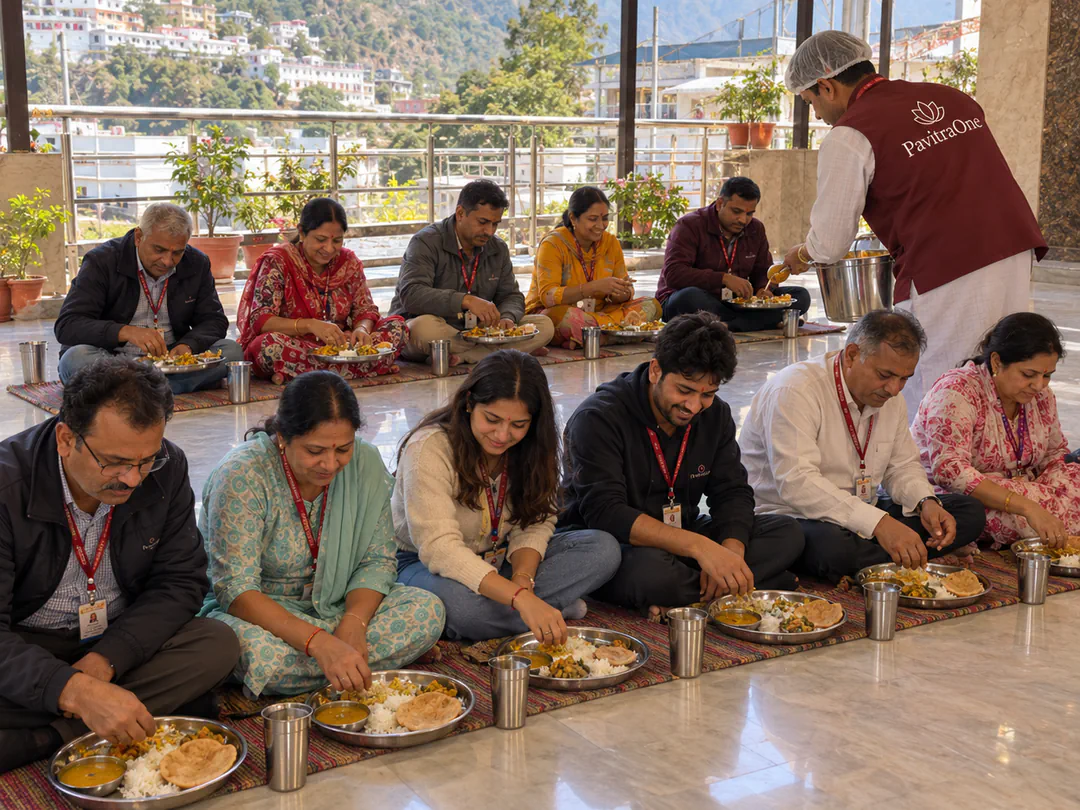
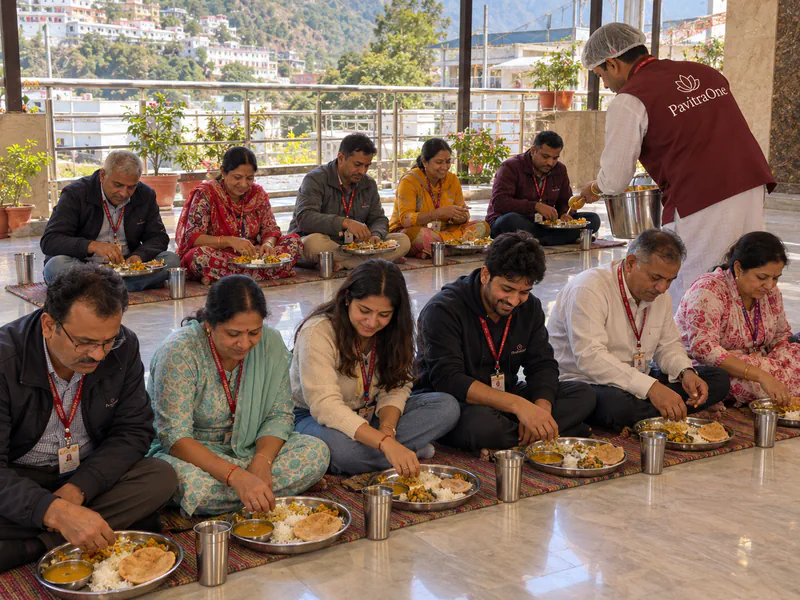
A fresh sattvik meal served to devotees and the needy in Katra, at the foot of Maa Vaishno Devi, with a sankalp in your family's name. Book it for a birthday, an anniversary, in memory of loved ones, or simply as seva on any day.
- 1
Choose plan and day
Pick the number of people and a date, add the occasion and sankalp name, and pay securely.
- 2
Sankalp in your name
On your seva day, the sankalp is taken in your family's name.
- 3
The meal is served
A fresh sattvik meal is served to devotees and the needy in Katra.
- 4
Video on WhatsApp
Your video and completion update follow, normally within 48 hours. Prasad, if chosen, is posted after.
Questions devotees ask
Frequently asked questions
Why is anna daan called mahadaan?
Because food sustains every life. The Taittiriya Upanishad calls food Brahman and the Bhagavad Gita says all beings come from food, so feeding the hungry is seen as the most complete gift: it fully satisfies the one who receives it.
Can I offer anna daan on a birthday or anniversary?
Yes. It is a much-loved way to mark a birthday or anniversary. With PavitraOne's Anna Seva you choose the occasion at checkout, and the sankalp is taken in the name you give.
Can anna daan be offered in memory of ancestors?
Yes. Offering food in the name of departed family members on their punyatithi, in Pitru Paksha or on Amavasya is a long-standing tradition.
Where is PavitraOne's Anna Seva performed?
In Katra, at the foot of Maa Vaishno Devi's Trikuta hills. A fresh sattvik meal is served to devotees and the needy with a sankalp in your family's name, and you receive a video of your seva on WhatsApp.
Offer Anna Seva in your family's name
A fresh sattvik meal for 5 to 51 people in Katra · sankalp in your name · video on WhatsApp
These stories are based on traditional texts and popular belief; their tellings can differ from region to region.