The story of Mata Vaishno Devi and the Trikuta hills
माता वैष्णो देवी और त्रिकूट पर्वत की कथा
The legend of Vaishnavi, Pandit Shridhar's bhandara, Bhairavnath's chase and the holy cave, and the places on the yatra from Katra to the Bhawan.
 Representational image
High on the three-peaked Trikuta mountain above Katra, in Jammu & Kashmir, is the cave shrine of Mata Vaishno Devi, one of the most visited pilgrimages in India. Pilgrims climb from Katra with “Jai Mata Di” (जय माता दी) on their lips to a cave where there is no carved idol: the Mother is worshipped as three natural rock forms, the Holy Pindis, revered as Maha Kali, Maha Lakshmi and Maha Saraswati. Devotees believe one reaches her only when she calls, and sing “चलो बुलावा आया है, माता ने बुलाया है।”
The legend of Vaishnavi
The shrine's legend, told by pilgrims and priests for generations, says that when adharma grew strong, the three great powers of the Devi joined in a divine girl. She was born in the south of India, in the home of Ratnakar Sagar, and came to be called Vaishnavi. From childhood she longed for the divine and went to the forest to meditate.
Tradition tells that she met Shri Ram during his exile, and that he asked her to meditate in the Trikuta hills, promising to come to her in a later age. So she came to the north and made the mountain her home.
Shridhar's bhandara and Bhairavnath
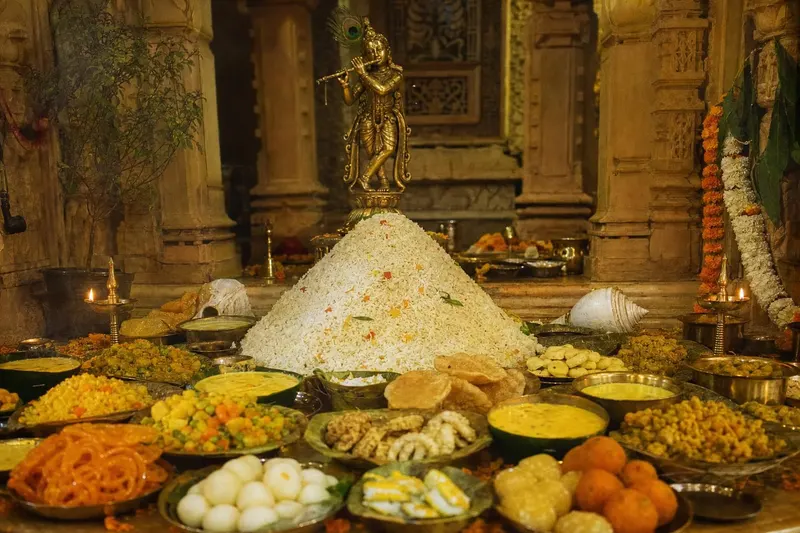
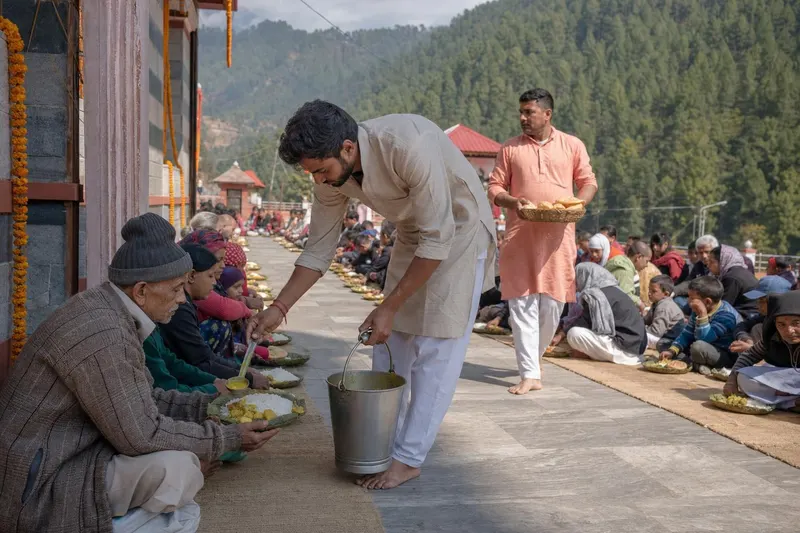
In Hansali village near Katra lived Pandit Shridhar, a poor but devoted bhakt. One Navratri, as he performed Kanya Pujan, the Mother joined the girls as a young girl and asked him to hold a bhandara for the whole village. By her grace his little home fed everyone in plenty.
Among the guests was Bhairavnath, a tantrik who sensed her power and set out to test her. The Mother left for the Trikuta hills, and he followed. On the way she shot an arrow into the earth and a spring burst out, Banganga; she rested and left her footprints at Charan Paduka; and she meditated for nine months in a narrow cave at Adhkuwari, the Garbh Joon (गर्भजून). At last, at the mouth of the holy cave, she took the form of Mahakali and beheaded Bhairavnath, whose head fell on a distant hilltop. In his final moment he begged forgiveness, and the Mother forgave him and blessed him: no pilgrim's yatra would be complete without a visit to his temple too.
ॐ जयन्ती मङ्गला काली भद्रकाली कपालिनी। दुर्गा क्षमा शिवा धात्री स्वाहा स्वधा नमोऽस्तु ते॥
Om, salutations to you: Jayanti, Mangala, Kali, Bhadrakali, Kapalini, Durga, Kshama, Shiva, Dhatri, Svaha and Svadha.
— Argala Stotram, verse 1, recited with the Durga Saptashati
The yatra from Katra
- Katra: the base town at the foot of the Trikuta hills, where the yatra begins.
- Banganga: the stream where the Mother's arrow struck the earth.
- Charan Paduka: the rock that bears her footprints.
- Adhkuwari: the halfway point, with the narrow Garbh Joon cave.
- The Bhawan: the holy cave with the three Pindis.
- Bhairon temple: the shrine of Bhairavnath above the Bhawan, where pilgrims complete the yatra.
The shrine is managed by the Shri Mata Vaishno Devi Shrine Board, which announces the yatra's routes, timings and rules. PavitraOne is an independent service and is not affiliated with the Board: our sevas are performed by our local team in Katra, at the foot of the hills, not at the shrine.
Based on traditional texts and popular belief; tellings differ from region to region. A puja or seva is a prayer made with faith and cannot promise a result.